
Media Streaming Server Architecture Case Study
Project Overview
During the development of a multimedia production environment, I designed and deployed a local streaming infrastructure capable of handling video ingestion, encoding, and distribution across multiple platforms.
The goal was to create a reliable, self-hosted streaming system that could support live broadcasting, recording, and content distribution while maintaining full control over the media pipeline.
This system enabled creators to stream gameplay, tutorials, and media content while also allowing recordings to be archived and repurposed for editing and publishing.
Project Type: Media Infrastructure / Streaming Server Architecture
Role: Systems Developer & Infrastructure Architect
The Challenge
Typical live streaming setups rely heavily on third-party platforms and cloud services. While convenient, this creates several limitations:
• Lack of control over the streaming pipeline
• Limited customization of encoding and routing
• Dependence on external services
• Difficulties managing multi-platform streaming
• No centralized system for ingest, record, and distribution
The objective of this project was to build a locally controlled streaming server capable of acting as a central hub for all media streaming operations.
Solution Architecture
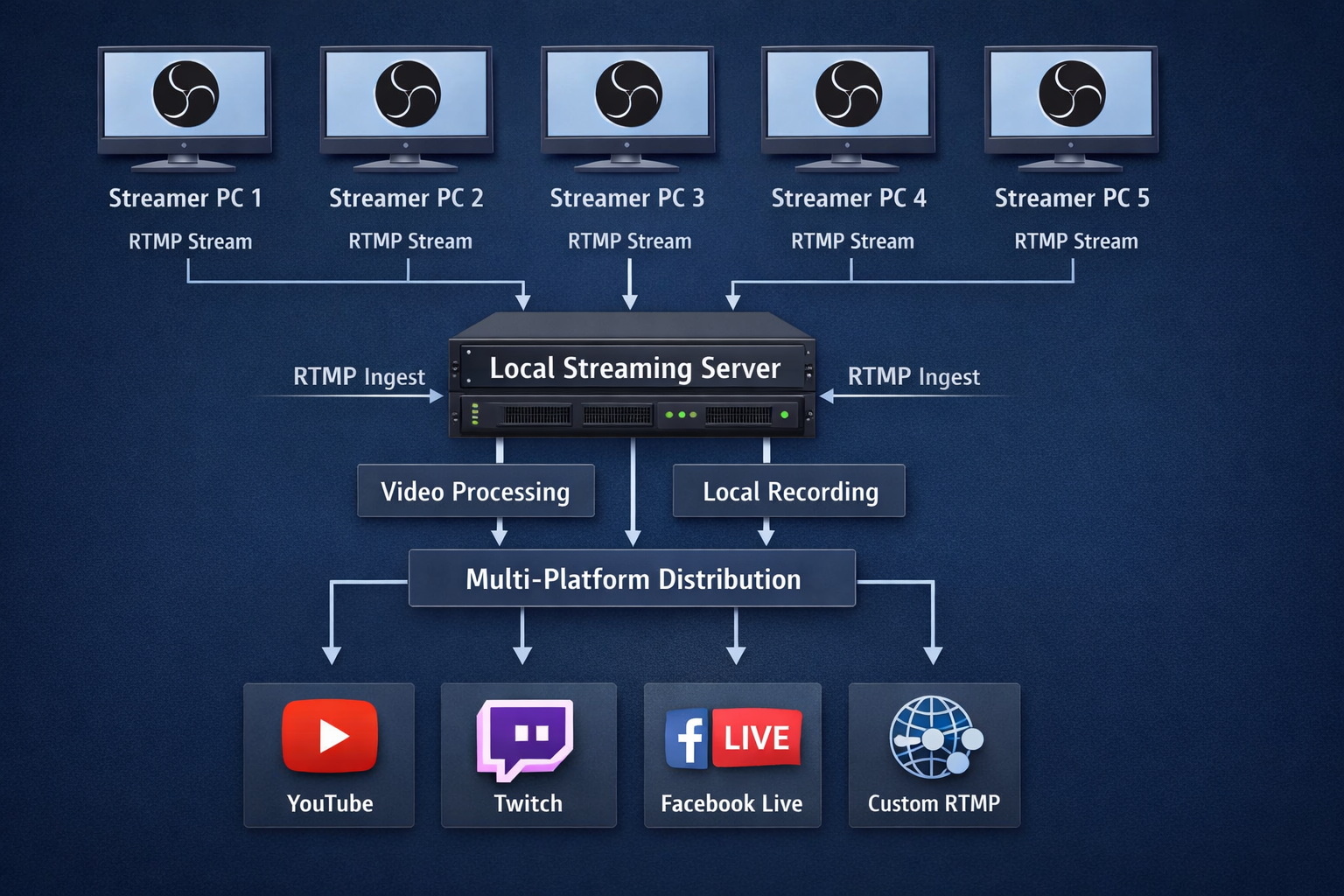
I implemented a local RTMP streaming server architecture capable of receiving video feeds from broadcasting software, processing the video stream, and redistributing it to multiple destinations.
The system included:
• Local RTMP ingestion server
• Real-time video encoding pipeline
• Multi-destination stream routing
• Local recording capabilities
• Scalable architecture for multiple streaming clients
The server acts as the central broadcast hub for all streaming operations.
System Architecture
Video Broadcast Flow
Streamer Computer (OBS)
↓
RTMP Stream Upload
↓
Local Streaming Server
↓
Stream Processing / Routing
↓
Distribution to Platforms or Local Storage
This architecture allows the broadcaster to send a single stream to the server, which can then distribute or record the media as needed.
Key Features Implemented
Centralized Streaming Hub
The streaming server acts as a media relay, allowing one broadcast stream to be distributed to multiple destinations.
This reduces CPU usage on the broadcasting computer and simplifies streaming workflows.
Real-Time Stream Processing
The system can:
• ingest RTMP streams
• route streams to multiple endpoints
• record streams locally
• prepare media files for editing workflows
This enables creators to easily repurpose content for:
• YouTube uploads
• social media clips
• highlight reels
• archived recordings
Local Recording Pipeline
Instead of relying on external services to record streams, the system records media directly to the local server.
Benefits include:
• higher recording quality
• faster access to raw footage
• easier editing workflows
Platform-Independent Broadcasting
By routing the stream through a local server, broadcasters can stream to multiple platforms without reconfiguring their broadcasting software.
This provides flexibility for:
• live streaming platforms
• private streaming environments
• internal monitoring feeds
Technical Stack
The streaming infrastructure integrates several technologies commonly used in media production workflows.
Broadcast Software
• OBS Studio
Streaming Protocol
• RTMP
Streaming Server
• MediaMTX (RTSP / RTMP streaming server)
Video Processing
• FFmpeg
Recording Format
• MKV / MP4 media containers
Implementation Highlights
Server Deployment
The streaming server was deployed locally to ensure:
• minimal latency
• high reliability
• full system control
Configuration included:
• stream ingest endpoints
• recording directories
• stream routing rules
• monitoring interfaces
Broadcasting Integration
Broadcasters simply configure OBS with a single RTMP endpoint, and the server handles the rest of the distribution pipeline.
This drastically simplifies the broadcasting workflow.
Performance Optimization
The system was optimized for stability and performance by:
• minimizing transcoding when unnecessary
• using hardware-accelerated encoding when available
• optimizing network throughput for local streaming
Results
The completed system created a fully self-hosted streaming environment capable of supporting live broadcasts, recordings, and content distribution.
Key outcomes:
• Reduced dependence on third-party streaming tools
• Simplified broadcasting workflows
• Enabled multi-platform streaming
• Improved recording quality for post-production
• Created a scalable streaming infrastructure
Impact
The system provides a professional-grade streaming pipeline typically used in media production studios.
By centralizing stream ingestion, recording, and routing, the platform enables creators to produce and distribute content more efficiently while maintaining full control over their media infrastructure.
Skills Demonstrated
Systems Architecture
Streaming Infrastructure
Media Server Deployment
Video Pipeline Design
OBS Integration
RTMP Protocol Implementation
FFmpeg Media Processing
Network Media Distribution