
Contactless Concession Ordering System
Melody 49 Drive-In Theater
Client
Melody 49 Drive-In Theater
Brookville, Ohio
Project Type
Operational Web Application / Contactless Ordering Platform
Role
Lead Developer / Systems Architect
Platform
WordPress + RestroPress
Technologies
PHP • JavaScript • Twilio SMS API • GeoIP Filtering • Thermal Printing • Browser Automation
Overview
During the COVID-19 pandemic, entertainment venues faced strict operational limitations due to social distancing requirements. For drive-in theaters, the concession stand traditionally a central gathering point presented a challenge. Long lines and crowded indoor spaces conflicted with safety guidelines and guest comfort.
To address this, I designed and built a contactless concession ordering system for the Melody 49 Drive-In Theater in Brookville, Ohio. The goal was to allow guests to order food directly from their vehicles and receive notifications when their order was ready for pickup.
The system integrated with the theater’s existing WordPress website and was engineered to support high-volume ordering during the peak pre-show window, when hundreds of guests typically purchase concessions before the movie begins.
The Challenge
The Melody 49 Drive-In can accommodate approximately 500 vehicles per showing, and nearly all concession orders occur within a two-hour window between gate opening and movie start.
This meant the system needed to reliably handle a potentially high number of simultaneous orders while maintaining a clear operational workflow for concession staff.
The key challenges included:
• Allowing guests to place orders from their vehicles
• Preventing external users from placing orders outside the venue
• Integrating with existing website infrastructure
• Delivering real-time order notifications
• Maintaining a workflow that concession staff could easily operate
• Ensuring the system could handle peak demand without failure
The platform needed to function as a digital extension of the concession stand, rather than disrupt existing operations.
The Solution
I developed a mobile-friendly online ordering platform integrated directly into the theater’s WordPress website using the RestroPress restaurant ordering system.
The system allowed guests to browse the concession menu, place orders from their smartphones, and receive automated notifications when their order was ready.
Orders were transmitted to the concession stand where staff could fulfill them just like a traditional restaurant order.
The architecture connected multiple systems to create a seamless workflow between customers and staff.
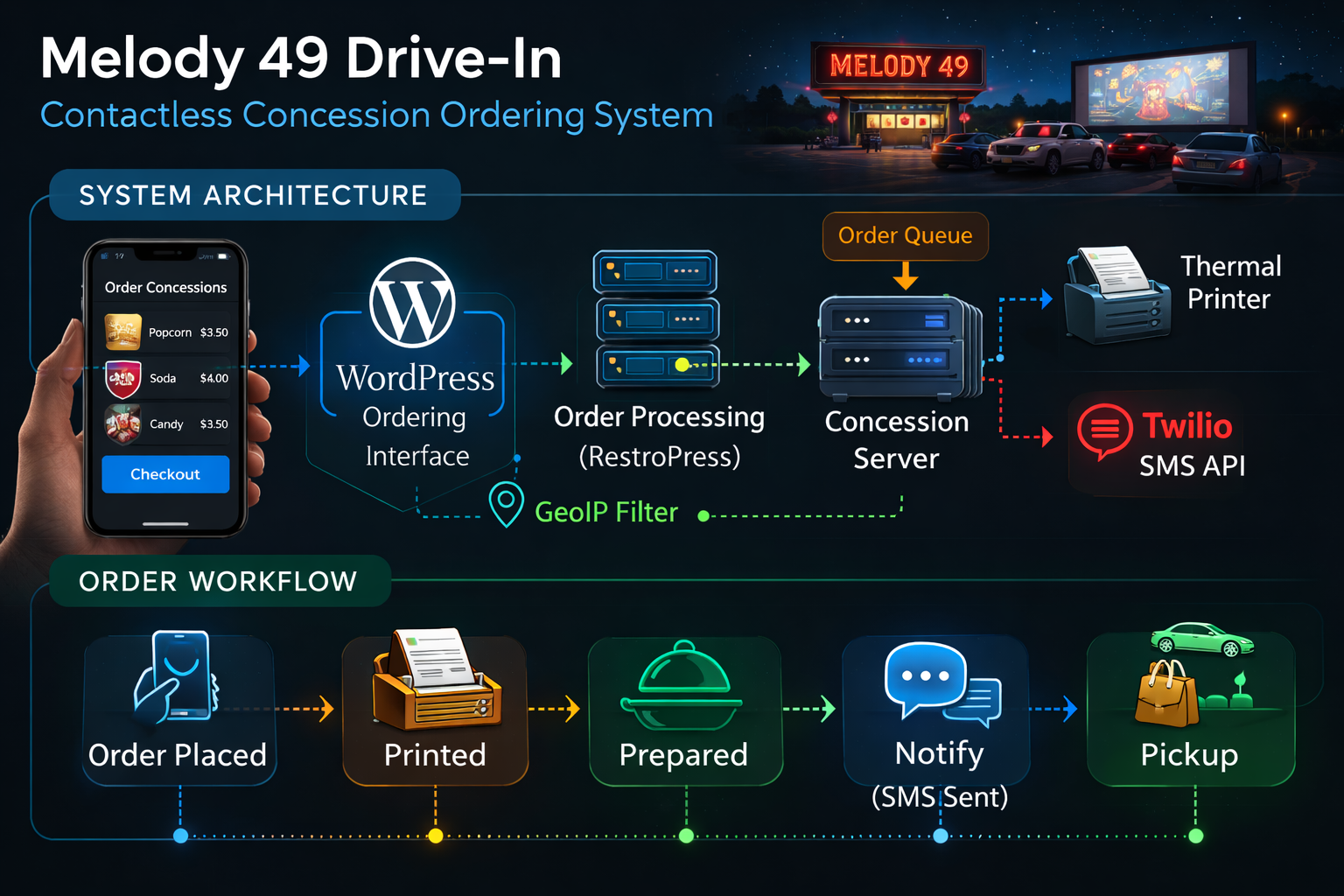
System Architecture
The platform was designed to create a reliable order pipeline from customer device to concession fulfillment.
Customer Phone
↓
WordPress Ordering Interface
↓
RestroPress Order Processing
↓
Concession Stand Server / Order Queue
↓
Thermal Receipt Printer
↓
Order Fulfillment by Staff
↓
Twilio SMS Notification to Customer
This approach ensured that staff received orders in a familiar format while customers received timely updates on their purchases.
Key Features
Geo-Restricted Ordering
To ensure that only guests physically present at the drive-in could place orders, ordering access was restricted using GeoIP filtering.
This prevented external users from accessing the ordering system and ensured that only customers on theater property could submit concession orders.
Mobile-Optimized Ordering Experience
The interface was designed specifically for mobile devices since customers would be ordering from their cars.
The ordering flow emphasized:
• fast menu browsing
• simple checkout
• large touch-friendly interface elements
• minimal steps to complete an order
This ensured that customers could place orders quickly and easily from their phones.
Real-Time Concession Workflow
When an order was placed, it was immediately transmitted to a server located inside the concession stand.
Each order was automatically printed to a thermal receipt printer, creating a workflow similar to a restaurant kitchen ticket.
This allowed concession staff to continue working within a familiar process while handling digital orders.
SMS Pickup Notifications
Once an order was prepared, concession staff could press a Notify Customer button in the system.
This triggered an automated text message sent through the Twilio SMS API, informing the customer that their order was ready for pickup.
This system reduced crowding inside the concession stand and allowed customers to remain in their vehicles until their food was ready.
Engineering Challenge: System Capacity
One of the most critical questions during development was whether the system could handle full drive-in capacity during peak ordering times.
Because live testing with hundreds of customers was impractical before deployment, I designed a custom automated load testing framework to simulate realistic ordering activity.
The goal was to replicate the behavior of hundreds of customers placing orders during the two-hour pre-show window.
Load Testing Strategy
To accurately simulate real-world conditions, I implemented a multi-layer testing system.
Simulated User Accounts
Ten automated user accounts were created on the development server to act as independent ordering agents.
These simulated separate customers interacting with the ordering system.
Randomized Order Generation
To prevent repetitive or unrealistic testing patterns, I built a spintax-based order generator that randomized product selections using product IDs.
This allowed the test environment to generate unique order combinations that more closely resembled real concession purchases.
Browser-Level Automation
Instead of sending direct server requests, I used JavaScript browser automation to simulate the full customer ordering process.
The automation replicated:
• menu browsing
• item selection
• checkout
• order submission
This ensured the system was tested under realistic user interaction conditions.
Maximum Capacity Simulation
The load testing environment simulated the theater’s full operational capacity:
500 potential concession orders
This scenario represented the maximum possible demand during a busy pre-show period.
Test Results
The stress test was executed three separate times under simulated peak demand conditions.
Results included:
• Successful processing of 500 simulated orders per test
• No server crashes or failures
• Stable order queue processing
• Reliable thermal printer output
• Successful delivery of SMS notifications
The results confirmed that the system could support full theater capacity without operational disruption.
Outcome
Although the system ultimately was not required due to evolving pandemic restrictions, the platform proved to be fully operational and production-ready.
The project demonstrated how a traditional entertainment venue could rapidly transition to a digital ordering infrastructure without disrupting staff workflows.
The platform successfully combined web technologies with real-world operational systems to create a scalable solution for concession ordering.
Technologies Used
WordPress
RestroPress
PHP
JavaScript
Twilio SMS API
GeoIP Filtering
Thermal Receipt Printer Integration
Browser Automation
Spintax Order Generation
Skills Demonstrated
Full-Stack Web Development
System Architecture Design
Automation Engineering
API Integration
Operational Workflow Design
High-Traffic System Planning
Load Testing and Performance Validation
Impact
• Designed to support 500 concurrent drive-in guests
• Enabled fully contactless concession ordering
• Integrated web ordering with real-world concession operations
• Successfully validated through automated high-volume testing
Key Takeaway
This project demonstrates the ability to design and engineer scalable systems that connect web platforms with physical operational environments.
By combining automation, infrastructure design, and performance testing, the system ensured that a high-capacity venue could safely and efficiently manage concession orders during peak demand.